
The best SEO reporting tools pull your rankings, traffic, and backlink data into clear, shareable reports - the top options in 2026 are ReportGarden, Semrush, Ahrefs, and Google's free tools (Analytics + Search Console), each suited to a different job. This guide breaks down 11 of them by what they're actually best for - agency client reporting, backlink analysis, on-page optimization, or free basics - so you can pick the right one without testing all eleven yourself.
We've grouped them by use case and included pricing, free trials, and the standout strength of each. Here's how to choose.
What is an SEO reporting tool?
An SEO reporting tool collects data about a website's search performance - keyword rankings, organic traffic, backlinks, and technical health - and turns it into a readable report for a client, a manager, or yourself. It answers one question clearly: is our SEO working, and where?
That's different from an SEO tool that does the underlying work (keyword research, site audits, link building). A reporting tool focuses on presenting results. Some platforms, like Semrush, do both; dedicated reporting platforms, like ReportGarden, focus on pulling data from many sources into one branded report.
How to choose an SEO reporting tool
Four things decide the right pick for you:
- Integrations - Can it connect the data sources you actually use (Google Search Console, GA4, Google Ads, Meta, rank trackers)? A report is only as good as the data feeding it.
- Reporting and customization - Can you build the report you need - white-label it, add commentary, schedule it - or are you stuck with fixed dashboards?
- Ease of use - How fast can you get from raw data to a report a client understands?
- Price and scale - Does the cost match how many sites or clients you manage?
If you run an agency, weight integrations and white-label reporting heavily. If you're optimizing a single site, free tools plus one focused platform usually cover it.
Quick pick: best tool for each need
- Best for agencies doing client reporting: ReportGarden
- Best free option: Google Analytics + Google Search Console (together)
- Best for backlink analysis: Ahrefs
- Best all-in-one suite: Semrush
- Best for large agencies with many dashboards: TapClicks
- Best budget all-rounder: SE Ranking
Comparison table
Pricing correct as of August 2026 - always check each tool's site for current rates.
The tools, one by one
1. ReportGarden
A client-reporting platform built for marketing agencies that pulls SEO, PPC, and social data into one branded report.
Best for: agencies producing recurring client reports across multiple channels.
Standout: white-label reports fed by 60+ integrations and 1000+ templates, plus a large template library.
Pros:
- Connects many data sources so SEO, ads, and social live in one report
- White-label / branded reports and client dashboards
- Template library speeds up recurring reporting
Cons:
- Reporting-first - you pair it with your data sources rather than replacing keyword research tools
- Full feature set (budgeting, invoicing) is more than a solo site owner needs
Pricing: from $75
Free trial: 7-day
- If you build recurring SEO reports for clients, this is the category ReportGarden is designed for - see the SEO reporting templates and client SEO reports
2. AgencyAnalytics
An agency-focused reporting platform centered on live, client-facing dashboards.
Best for: agencies that want clients to log into a live dashboard.
Standout: shareable client dashboards with broad marketing integrations.
Pros:
- Wide range of marketing integrations
- Live dashboards clients can access anytime
- White-label branding
Cons:
- Reporting-focused, not a deep SEO research suite
- Free trial: Yes
3. TapClicks
A marketing analytics and dashboard platform aimed at larger agencies and teams.
Best for: large agencies unifying many data sources at scale.
Standout: unified multi-source dashboards with a very large connector library.
Pros:
- Extensive data connectors
- Enterprise-grade dashboards and workflow/order management
- Scales to many clients and channels
Cons:
- Higher price point
- More complexity than small teams need
- Free trial: Yes
4. Semrush
An all-in-one SEO and marketing suite that also builds reports.
Best for: teams that want research and reporting in one platform.
Standout: breadth - keyword research, competitor analysis, site audits, and reporting together.
Pros:
- Comprehensive toolset in one login
- Strong keyword and competitor data
- Built-in report builder (My Reports)
Cons:
- Expensive at higher tiers
- Steep learning curve for beginners.
- Free trial: 7-day
5. Ahrefs
An SEO toolset best known for backlink and competitor data.
Best for: backlink analysis and competitor research.
Standout: depth of its backlink index.
Pros:
- Large, frequently updated backlink index
- Strong Site Explorer and keyword data
- Good for competitor gap analysis
Cons:
- White-label / client reporting is limited versus dedicated reporting tools
Free trial: $7 / 7-day
6. Moz
An approachable SEO suite with strong local and reputation features.
Best for: local SEO and rank tracking.
Standout: local SEO tools plus the well-known Domain Authority metric.
Pros:
- Good local SEO and rank tracking
- Beginner-friendly interface
- Established Domain Authority metric
Cons:
- Smaller index than Ahrefs or Semrush
- Reporting is fairly basic
Free trial: 30-day
7. SE Ranking
A well-rounded SEO platform positioned on value.
Best for: budget-conscious teams wanting rank tracking plus reporting.
Standout: strong feature-to-price ratio, including white-label reports.
Pros:
- Affordable relative to premium suites
- Rank tracking and a report builder
- White-label options
Cons:
- Data depth is smaller than top-tier suites
- Free trial: Yes
8. SurferSEO
A content optimization tool that benchmarks pages against the SERP.
Best for: on-page and content optimization.
Standout: content audits and an editor scored against ranking pages.
Pros:
- Content editor and SERP analyzer
- Practical for writers optimizing drafts
- Clear on-page recommendations
Cons:
- Narrow scope - content/on-page, not full reporting
- Some features are add-ons
Free trial: Yes
9. Yoast SEO
A WordPress plugin for on-page SEO, aimed at beginners.
Best for: WordPress users optimizing pages as they write.
Standout: simple, inline on-page and readability guidance inside WordPress.
Pros:
- Easy to use, widely adopted
- Useful free tier
- Live on-page feedback while editing
Cons:
- WordPress only
- On-page focused, with little in the way of reporting
Free trial: Yes
10. Google Analytics (GA4)
Google's free web analytics platform.
Best for: free traffic and behavior data.
Standout: the web analytics standard, integrated across Google's stack.
Pros:
- Free and comprehensive
- Deep traffic, behavior, and conversion data
- Integrates with Search Console, Google Ads, Looker Studio
Cons:
- GA4 has a learning curve
- Not SEO-specific - no keyword rankings
Pricing: Free
11. Google Search Console
Google's free tool for search performance and index health.
Best for: free ranking, impression, and indexing data straight from Google.
Standout: direct, first-party Google search data.
Pros:
- Free
- Real query, impression, click, and position data
- Index coverage and technical issue alerts
Cons:
- 16-month data window
- No competitor data; basic reporting on its own
Pricing: Free
How we evaluated these tools
We evaluated each tool on integrations, reporting and customization, ease of use, and price. Where possible we based notes on hands-on use building client reports; for tools we use less, we drew on documented features and verified user reviews.
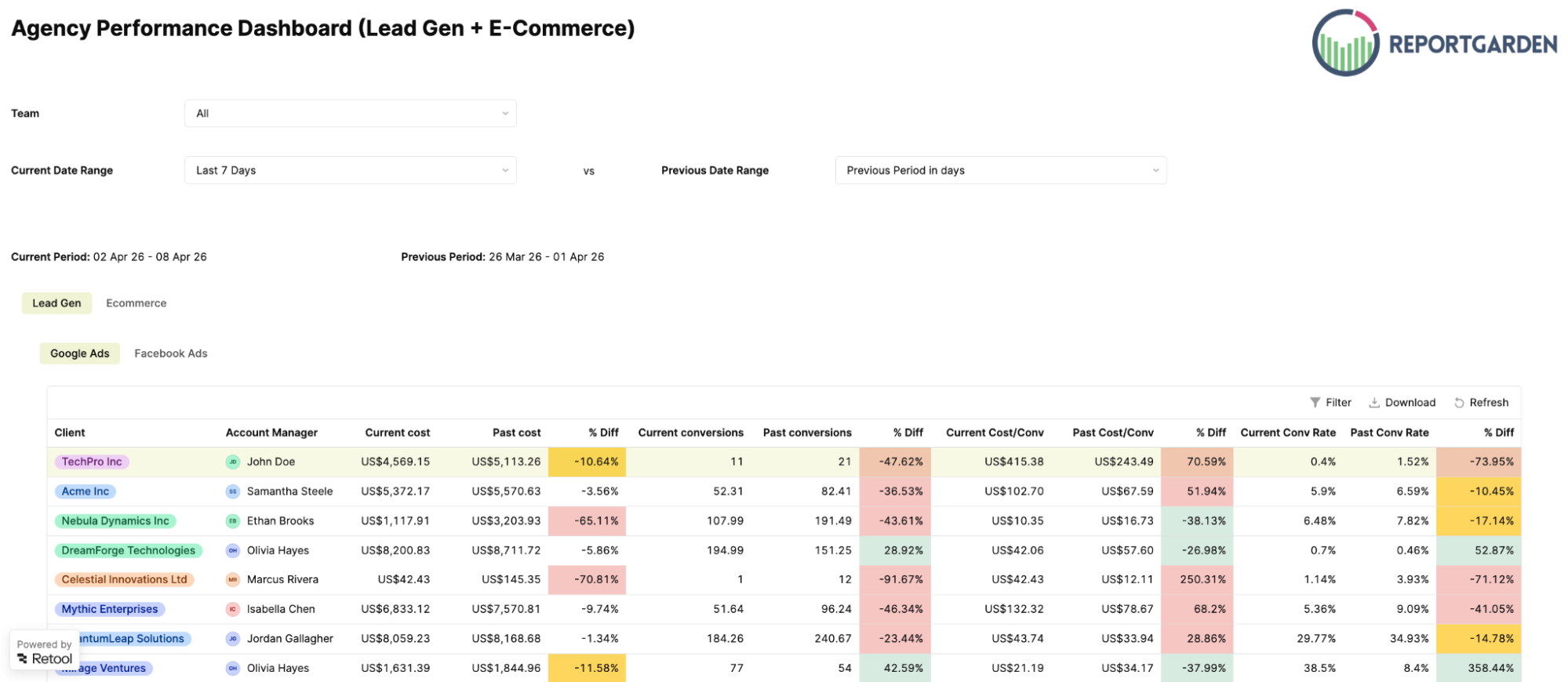
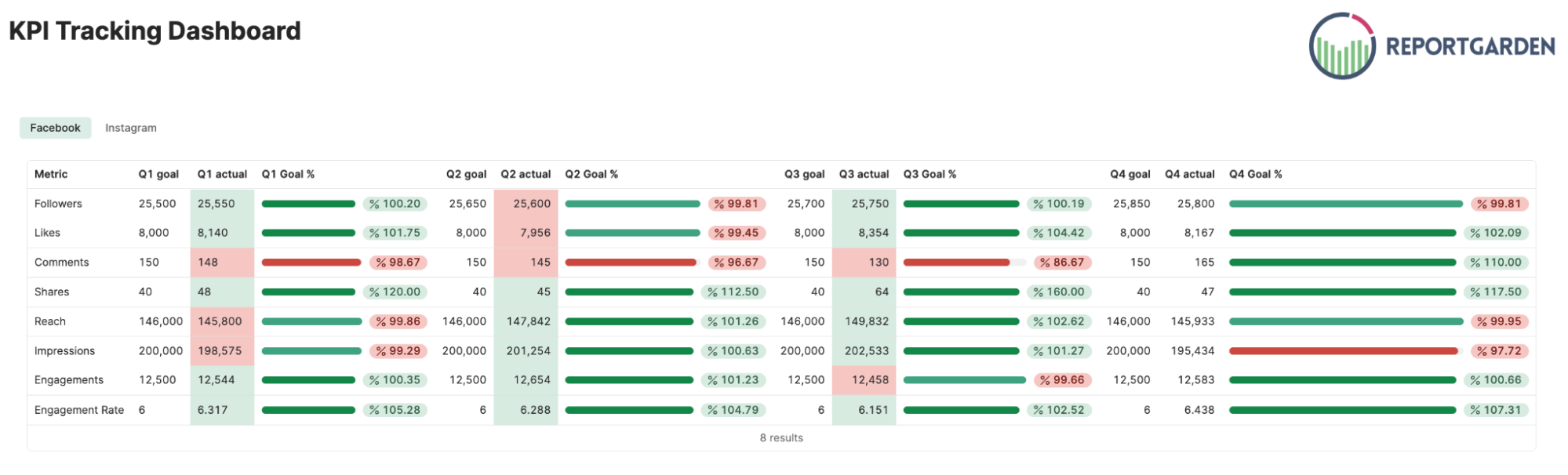
From working closely with agencies, one thing that stood out early on was how manual reporting workflows were with a lot of reliance on exports and spreadsheets.
That has definitely evolved over time. Agencies are now more open to automation, especially for data aggregation and scheduled reporting. But one thing that hasn’t changed much is how particular they are about presentation.
Even when the data is accurate, a lot of effort goes into making sure reports match client branding - especially colors, layout, and overall look and feel. These reports are client-facing, so perception matters as much as accuracy.
Rank higher with the right tool
Pick based on the job, not the brand name. If you're a solo site owner, start free with Google Search Console and Analytics and add a focused tool as you grow. If you're an agency spending hours each month assembling client reports, a dedicated reporting platform pays for itself in time saved.
For agency client reporting specifically, ReportGarden centralizes SEO, PPC, and social data into one branded report - you can start from a ready-made SEO report template or see how client SEO reports come together.
FAQ
What is the best SEO reporting tool for agencies?
For agencies focused on client reporting across multiple channels, ReportGarden is a strong fit thanks to its integrations and white-label reports. Semrush and AgencyAnalytics are common alternatives.
Are there free SEO reporting tools?
Yes. Google Analytics and Google Search Console are free and cover core SEO data together. Paid tools add automation, white-label reports, and multi-source dashboards.
What's the difference between an SEO tool and an SEO reporting tool?
An SEO tool helps you do the work - keyword research, audits, link building. An SEO reporting tool focuses on presenting the results clearly to clients or stakeholders. Some, like Semrush, do both.
How much do SEO reporting tools cost?
They range from free (Google's tools) to roughly 70–600+ per month depending on features, integrations, and how many clients you manage.
.png)


