Becoming a customer can look simple from the outside, but in practice the path is rarely a straight line. A marketing funnel maps that path - it shows how someone moves from first discovering a brand to taking the action you want, and where they drop off along the way.
For agencies, understanding the different types of marketing funnels makes it easier to match the right marketing channels, content, and strategies to each stage of the customer journey. In this guide, we'll break down seven of the most common marketing funnels for agencies and explain how to use each one, with examples.
What Is a Marketing Funnel?
A marketing funnel is a model that breaks the buyer's journey into stages, from the first interaction with an agency to the final action you want them to take. It helps marketers understand what happens at each step - and where prospects lose interest before converting.
Most funnels map loosely to three broad stages: the top of the funnel (awareness), the middle of the funnel (consideration), and the bottom of the funnel (decision or conversion) - often shortened to TOFU, MOFU, and BOFU.
You may often come across the simplest version of a funnel:
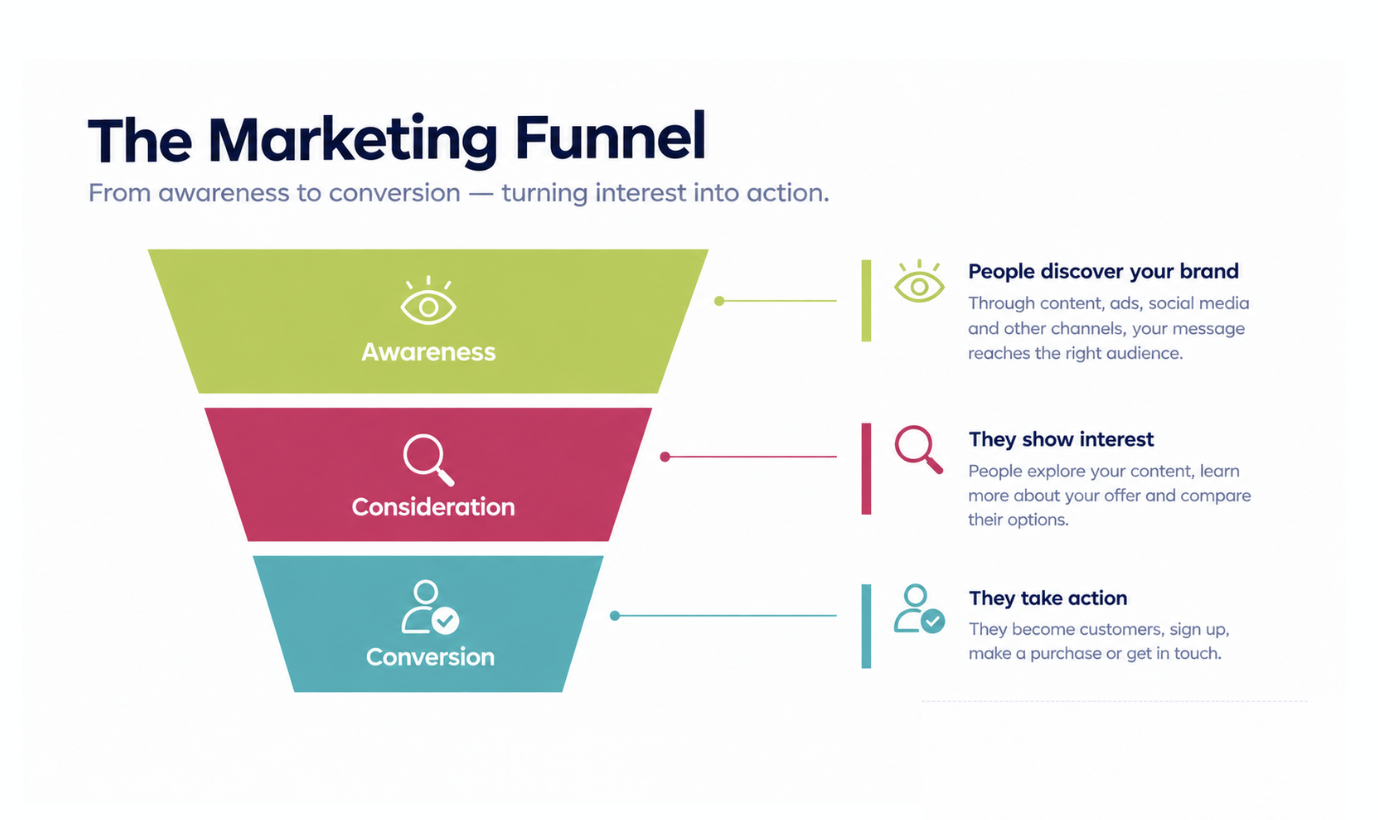
But that doesn't mean it's the only funnel that fits every business or campaign. Depending on the product, buyer journey, sales cycle, and other factors, a funnel can include many more marketing funnel stages.
7 Most Common Funnel Types Every Agency Can Use
1. Lead Generation Funnel
A lead generation funnel moves people from awareness and consideration to becoming a lead. The main goal here isn't necessarily a sale - it's capturing a prospect's contact information and starting to build a relationship.
Because of that, the early stages can be broad. The funnel starts by attracting attention with different types of content across channels such as:
- Social media
- Paid and unpaid ads
- SEO and content
- Email marketing
- Other marketing channels
The channel and content can be almost anything. What matters is using platforms and strategies that genuinely capture attention and move people to the next step.
Once people become interested, they enter the consideration stage. They might visit a website, read more about the service, compare options, or look for more information. From there, they can be directed to a landing page or another page built for action.
Then comes the final stage. A visitor fills out a form, downloads a guide, books a call, or takes another step that signals real interest. That's how they become a lead.
When to use this funnel?
This funnel suits agencies that want to build a stronger relationship with potential customers. It also works well when clients need more information before they're ready to buy, or when becoming a lead is an important step in the overall customer journey.
For example, imagine a link building agency offering to browse its guest post inventory for free. Its funnel can be broken down into these stages:
- Awareness. A business owner finds the agency through a blog post with an inventory widget and clicks read more here.
- Consideration. They visit the landing page and learn more about the inventory.
- Conversion. They sign up to access the guest post inventory.
They've become a lead - but not yet a customer.
2. Sales Funnel
A sales funnel can look a lot like a lead generation funnel. The difference is what happens at the end.
A lead generation funnel ends when a person becomes a lead. A sales funnel goes one step further and aims to turn that lead into a customer. The process can include several marketing funnel stages - awareness, consideration, evaluation, decision, and so on — but the final stage is always conversion.
When to use this funnel?
A sales funnel is useful for almost any business that wants to understand how potential customers move toward a purchase. The exact steps vary with the product, sales process, and customer journey.
For example, imagine a web design agency offering a website redesign service. Its funnel can be broken down into these stages:
- Awareness. A business owner finds the agency through a LinkedIn post.
- Consideration. They visit the website and check the agency's portfolio.
- Decision. They book a consultation to discuss their project with the agency.
- Conversion. They sign a contract and become a customer.
3. SEO & Content Funnel
An SEO and content funnel uses organic search and optimized articles to move people through the buying journey. The agency creates content that matches what people are searching for at each stage - informational content at the top, comparison and decision content further down.
When to use this funnel?
This funnel suits agencies that want to attract potential customers through organic search. It works especially well when people need to research a problem or compare solutions before deciding.
For example, imagine an SEO agency offering all types of optimization services.
- Awareness. A business owner searches for "how to rank on Google" and finds the agency's guide.
- Consideration. They read a case study about Google rankings and explore the agency's service page.
- Conversion. They book a consultation to discuss their needs.
4. Webinar Funnel
In a webinar funnel, webinars are the main tool for attracting and engaging potential customers. Agencies invite people to an online event where they share useful information and demonstrate their expertise. Webinar platforms also track registrations and attendance, which can feed follow-ups.
When to use this funnel?
This funnel is useful for agencies selling services that require education and trust before a prospect is ready to buy.
For example, imagine a marketing agency running a webinar about generating leads with content.
- Awareness. A business owner sees a social media post or email promoting the webinar.
- Consideration. They visit the registration page and sign up.
- Engagement. They attend the webinar and learn more about the topic.
- Conversion. After the webinar, they book a consultation with the agency.
Engagement is one of the most important stages in this funnel. It's where the agency interacts directly with potential customers and builds trust. And since not everyone who registers will attend live, agencies can follow up with no-shows by offering a recording or other relevant content.
5. Paid Advertising Funnel
In this funnel, as you could already guess, ads are what move people through different stages of the buying journey.
Here, awareness is one of the most important stages agencies need to think about. Agencies can use different ad messages and campaign goals depending on how familiar people are with the business. They can also use campaign reporting to track performance and understand which parts of the funnel need improvement.
When to use this funnel?
This funnel suits agencies that want to reach a specific audience and bring paid traffic to their website or landing pages. It's also useful when a business wants to bring people back after a first interaction through marketing retargeting.
For example, imagine an agency promoting its lead generation service.
- Awareness. A business owner sees an ad introducing the agency and its services.
- Consideration. They click the ad and visit a case study or service page.
- Decision. After visiting the website, they see a retargeting ad with a more specific offer.
- Conversion. They click the ad and book a consultation.
The important part of this marketing funnel strategy is that the ads can change as people move through the journey. Someone seeing the agency for the first time needs a different message than someone who has already visited the website.
6. Email Marketing Funnel
In an email marketing funnel, every step except the first and last happens through email. The first step is getting people to join an email list. The last is getting the prospect to take the desired action. Between those two points, there can be several stages, depending on what the agency wants to achieve.
For instance, emails can be used to:
- Provide useful information
- Introduce a product or service
- Share customer reviews
- Offer a special deal
When to use this funnel?
Agencies can use this funnel to plan and structure an email marketing campaign. It's especially useful when several emails are needed to nurture people from their first interaction to the desired action.
For example, imagine an AI visibility agency promoting its services for small businesses.
- Awareness. A customer subscribes to the brand's email list in return for a lead magnet checklist on AI optimization.
- Consideration. They receive emails with generative engine optimization (GEO) tips and learn more about the services.
- Decision. The agency sends an email with customer reviews and more details about its package for small businesses.
- Conversion. They use the link in the email to book a call.
7. Referral Funnel
A referral funnel is different from the others. Here, people discover a business through a recommendation from someone they already know and trust. After that first interaction, they go through the usual steps - learning more, considering the offer, and eventually becoming a customer.
When to use this funnel?
Agencies can use this funnel when they already have satisfied customers or strong business relationships that can bring in new potential clients. In those cases, referral marketing strategies work best when a clear funnel supports them.
For example, imagine a digital marketing agency with a referral program for its existing customers. Its funnel can be broken down into these stages:
- Awareness. An existing client recommends the agency to a business partner.
- Consideration. The partner visits the agency's website and learns more about its services.
- Decision. They choose a service they're interested in.
- Conversion. They book a call with the agency.
The difference is that the new customer arrives through a recommendation from someone they trust. These funnels tend to work far better when you add proper incentives for everyone involved.
Frequently Asked Questions
What are the main types of marketing funnels?
The most common types of marketing funnels for agencies are the lead generation funnel, sales funnel, SEO and content funnel, webinar funnel, paid advertising funnel, email marketing funnel, and referral funnel. Many agencies run several at once.
What's the difference between a lead generation funnel and a sales funnel?
A lead generation funnel ends when a prospect becomes a lead by sharing their contact details. A sales funnel continues past that point and aims to turn the lead into a paying customer, ending in conversion.
What are the stages of a marketing funnel?
Most marketing funnels follow three broad stages: awareness (top of funnel), consideration (middle of funnel), and decision or conversion (bottom of funnel). Specific funnels add stages such as engagement or nurturing in between.
How do agencies track marketing funnel performance?
Agencies track funnel performance by measuring how prospects move between stages - impressions and clicks at the top, engagement and sign-ups in the middle, and conversions at the bottom — then reviewing where people drop off. A reporting tool that pulls this data into clear client reports makes it easier to spot gaps and show progress.
Conclusion
There are many types of marketing funnels, and each serves a different purpose. Agencies can also combine several at once — there's no single right approach, since every strategy calls for different tactics and every agency is unique.
The key is to understand the customer journey and choose the funnel that fits it best. It's also important to have a good reporting tool that can help you track how your clients are progressing through the funnel and where your gaps are. For this, you can try ReportGarden for free.